
 EN
You wouldn't ship a container without weighing it. Yet every month, megawatt-hours of C&I battery storage go live after nothing more than a 25% capacity spot-check and a green light from the BMS.
The result? Projects that "pass commissioning" in June and start underperforming by September — capacity shortfalls, phantom SOC readings, and thermal events that no one can explain.
Here's the uncomfortable truth: most of the defects that kill a BESS project's ROI are invisible below 50% depth of discharge (DOD). They only show up when you take the battery through a full, honest, 100% charge/discharge cycle.
What "Hidden Defects" Actually Look Like
Factory test data tells you what the cells should do. Full-capacity testing tells you what the integrated system actually does — after transport vibration, on-site assembly, torque variances, and weeks of storage at partial SOC. This is where the real-world failures live:
1. Capacity below nameplate. Cell-level factory grading doesn't guarantee a rack will deliver. One mis-wired module, one weak batch, one temperature gradient across the cabinet — and your 5 MWh system quietly behaves like 4.6 MWh. At 100% DOD, the shortfall is unmistakable. At 25%, it hides inside the flat region of the discharge curve.
2. Cell-to-cell imbalance that grows with cycling. A pack can look balanced at rest and still diverge badly as SOC approaches the extremes. Divergent cells are the single best early predictor of accelerated degradation and thermal risk — and the imbalance signature is only fully visible near the top and bottom of charge.
3. BMS protection logic that fails exactly when it matters. Undervoltage cutoff, overcurrent during regenerative charge, SOC calibration drift — these faults reveal themselves under real full-cycle stress, not during static functional checks. An SOC meter that's off by 8% is a nuisance at noon and an emergency at 2 a.m.
4. Interconnection and thermal problems under sustained current. A loose busbar or a blocked cooling channel holds its secret until the system runs at rated power for hours. Full-capacity cycling at realistic C-rates is the only test that flushes these issues out before the customer finds them.
5. Warranty disputes you can't win without baseline data. A documented, full-capacity acceptance test creates the performance baseline that every future warranty claim will be measured against. Skip it, and two years from now you're arguing with the integrator about whose number is right — with no number at all.
The Real Reason Projects Skip It: Electricity Costs
Ask any EPC why full-capacity acceptance testing gets reduced to spot checks, and the answer is rarely technical. It's the power bill.
The traditional method is a resistive load bank: charge the battery from the grid, then dump the discharge energy into resistors — converted entirely to heat. For a single 1 MWh rack, one full cycle looks like this:
|
Resistive load bank |
Energy-regenerative tester |
|
|
Energy drawn to charge (from grid) |
~1.05 MWh |
~1.05 MWh |
|
Discharge energy |
~1.0 MWh burned as heat |
~90% fed back to grid |
|
Net grid consumption per cycle |
~2.05 MWh |
~0.15 MWh |
|
Extra HVAC load to remove test heat |
Significant |
Negligible |
Energy Feedback: Same Rigor, Fraction of the Cost
This is precisely where energy-regenerative (energy-feedback) DC cyclers change the economics of testing:
- 90%+ of discharge energy is recovered and fed back to the grid through bidirectional power electronics — the discharge test effectively pays for part of itself.
- Full 100% DOD charge/discharge cycles become affordable, so "we only have budget for a spot check" stops being a valid excuse.
- Four-quadrant control supports realistic charge/discharge profiles at rated C-rates, including the pulsed and stepped profiles specified in IEC 62619, UL 1973, and grid-code test procedures.
- Cluster-level precision — per-channel voltage/current resolution high enough to catch single-cell divergence trends that averaged rack readings hide.
What a Proper Full-Capacity Acceptance Test Should Include
A commissioning-grade protocol we recommend to EPCs and integrators:
- Baseline capacity verification — full charge to 100% SOC, rest per standard, full discharge to cutoff at rated power; record delivered Ah/kWh vs. nameplate.
- Rack-to-rack and cluster-to-cluster consistency — compare capacity, internal resistance trend, and delta-V curves across all parallel strings.
- BMS validation under stress — verify undervoltage/overcurrent/thermal protection triggers at real extremes, and calibrate SOC against measured capacity.
- Sustained-power thermal assessment — hold rated power through the cycle and log temperature gradients across the cabinet.
- Documented baseline report — the reference dataset for warranty, O&M trending, and future capacity audits.
The Bottom Line
Full-capacity testing is not a luxury or a box-ticking exercise. It is the only step that verifies what the customer actually bought — and with energy-feedback technology, the classic excuse (the electricity bill) has collapsed by 90%+.
The projects that skip it don't save money. They just schedule their failure discovery for the first summer peak, when it costs the most.
Test With Confidence
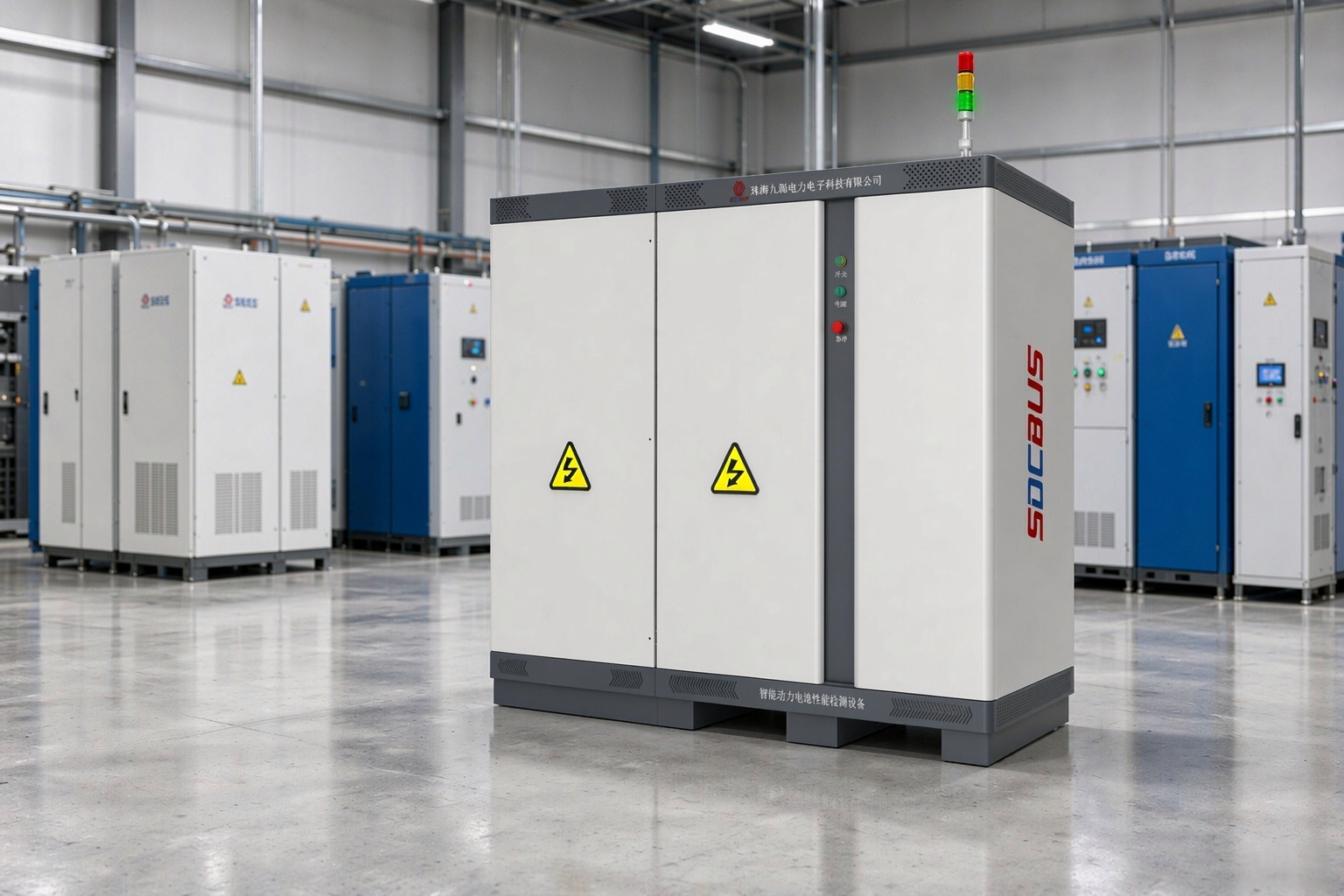
JIUYUAN's SDCBUS series energy-regenerative battery testing systems are built for exactly this: full-capacity charge/discharge acceptance testing for C&I BESS, with 90%+ energy recovery, cluster-level measurement precision, and compliance-oriented test profiles for IEC/UL certification workflows.
Planning a commissioning or acceptance test? Contact our team for a test-plan review and an electricity-cost comparison for your specific project — we'll show you the numbers before you commit